

While the innovation has accelerated. It has also created a new security challenge. Every application, service, workload, and automation process relies on secrets. Secrets such as passwords, API keys, tokens, certificates, and encryption keys.
The problem is these secrets often end up spilling.
They get stored in configuration files. They get embedded in source code. They get shared across teams. They get forgotten inside legacy systems. Over time, organisations lose visibility into who has access to what. This makes secrets one of the most common attack vectors in modern environments.
Why traditional approaches fall short
For years, security strategies were built around the network perimeter. If a user or application was inside the network, it was generally trusted.
That model no longer works.
Today’s workloads move across public clouds. Across private data centers. Across Kubernetes clusters. Across edge environments. In many organisations, machine identities now vastly outnumber human users. A single application can interact with dozens of services, databases, and APIs within seconds.
In such an environment, trust can no longer be based on location. It has to be based on identity.
Organisations need a way to verify who or what, is requesting access before sensitive information is shared.

Introducing HashiCorp Vault
HashiCorp Vault was designed to solve this problem.
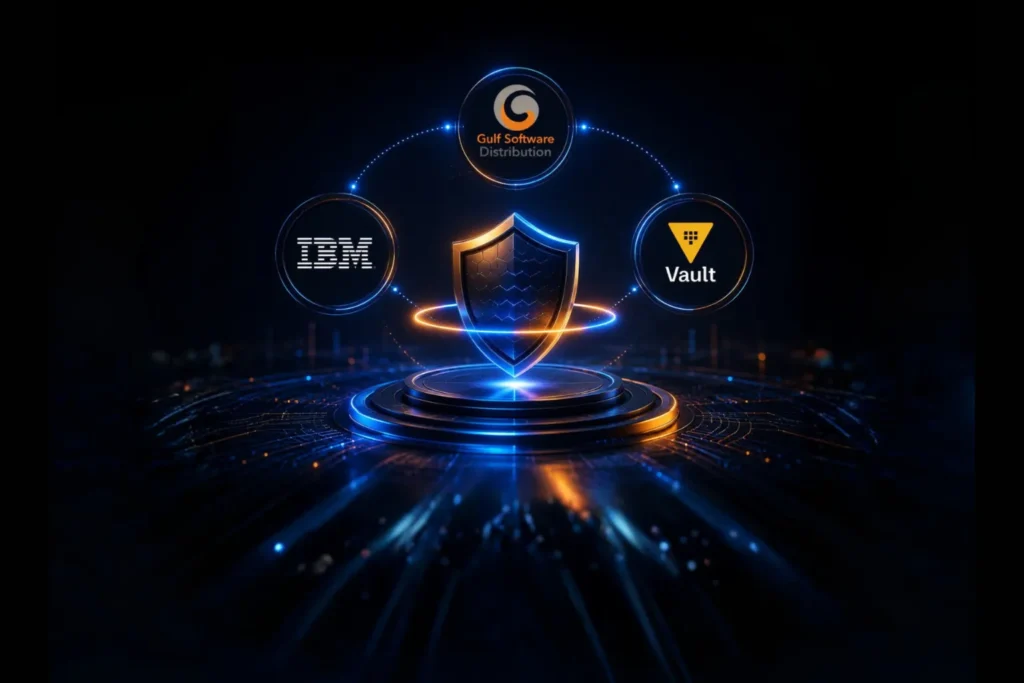
At its core, Vault acts as a centralised platform for managing secrets, certificates, encryption keys, and sensitive data. Instead of scattering credentials across different systems. The organisations can manage them from a single trusted source.
When an application, service, or user requests access, Vault first verifies its identity. Based on predefined policies, it then provides only the permissions required to perform a specific task.
This approach follows the principle of least privilege; giving access only when needed and only to the resources required. For security teams, that means tighter control. For developers, it means secure access without introducing additional friction.

Moving beyond static credentials
One of Vault’s most valuable capabilities is its ability to replace static credentials with dynamic ones.
Traditionally, database passwords or access tokens could remain active for months or even years. If those credentials were exposed, attackers could potentially use them for an extended period.
Vault changes that model.
Credentials can be generated on demand, assigned to a specific workload, and automatically revoked once their purpose has been served. This dramatically reduces the window of opportunity for misuse while removing much of the manual effort involved in credential management.
The result is stronger security without increasing operational complexity.

Securing the rise of Non-Human Identities
As organisations embrace automation and AI, the number of non-human identities continues to grow.
Microservices, containers, CI/CD pipelines, bots, and AI agents all require secure access to systems and data. Managing these identities manually is becoming increasingly difficult.
Vault helps organisations address this challenge by providing a consistent framework for authenticating and authorising both human and machine identities. Whether the request comes from an employee, an application, or an AI-driven workflow, access decisions are governed through the same centralised policies.
This becomes particularly important as enterprises begin integrating AI into business-critical processes where security, accountability, and governance are essential.
More than secrets management
Although Vault is best known for secrets management, its capabilities extend much further.
Organisations can use the platform to manage certificate lifecycles, automate encryption key management, and protect sensitive information through encryption and tokenisation. These capabilities are particularly valuable for industries dealing with regulated data, such as financial services, healthcare, telecommunications, and government.
By bringing these functions together under a single platform, organisations gain greater consistency in how security policies are implemented across their environments.

Building security that scales
One of the biggest challenges facing security leaders today is balancing protection with agility.
Security controls that slow development teams often lead to workarounds. On the other hand, moving fast without governance increases risk.
HashiCorp Vault helps bridge that gap. By automating credential management, enforcing identity-based access controls, and providing comprehensive audit visibility, it enables organizations to strengthen security while maintaining developer productivity.
As cloud adoption continues to grow and AI-driven workloads become more common, identity is increasingly replacing the traditional network perimeter as the foundation of enterprise security.
Vault is built around that reality.
And for organisations looking to secure modern infrastructure without sacrificing speed or scalability, it has become an increasingly important part of the security stack.
Let’s be honest: ten years ago, security was easy. You had a data center, a massive firewall, and a predictable release cycle. If you were inside the network, you were trusted. If you were outside, you weren’t.
Today? That model is completely dead.
Between multi-cloud setups, Kubernetes, and developers pushing code fifty times a day, there is no “inside” anymore. But the real headache isn’t just the architecture, it’s the sheer volume of credentials keeping the whole machine running. We’re talking about database passwords, API keys, SSH keys, and TLS certificates scattered across GitHub repos, random .env files, Jenkins pipelines, and Slack messages.
When a company gets breached today, it’s rarely a sophisticated zero-day exploit. It’s almost always because someone left an AWS root key in a public repository.
That is why HashiCorp Vault has essentially become the industry standard. It’s not just a fancy password manager for apps; it completely changes how we handle trust.
The Myth of the Perimeter (and the Rise of Machine Identities)
We used to build security around location. Now, we have to build it around identity.
Think about it: you probably have more microservices, containers, and automated CI/CD bots running right now than actual human employees. A single user click on a website might trigger twenty different service-to-service calls in a few seconds. You can’t protect that with an IP whitelist or a traditional firewall.
Vault forces a shift to a “Zero Trust” approach. It doesn’t care where a request comes from. It asks: What are you? Prove your identity (via AWS IAM, Kubernetes, etc.), and I will give you exactly the bare minimum access you need to do your job for the next five minutes.
The Killer Feature: Dynamic Secrets
If you ask any DevOps engineer why they love Vault, they’ll tell you it’s because of dynamic secrets.
In a traditional setup, you create a database user called app_user, give it a password, paste that password into a config file, and pray nobody leaks it. That password stays there for months or years because rotating it manually is an operational nightmare that breaks things. If an attacker gets that password, they own your database until someone notices.
Vault flips this on its head. Instead of giving an app a permanent password, the app asks Vault for access. Vault talks to the database, generates a brand new, temporary set of credentials on the fly, and hands them to the app with a strict time-to-live (TTL). Once the app is done, or the timer runs out, Vault automatically destroys those credentials.
If a hacker steals that key? It doesn’t matter. It’s already expired.
Moving Past the “Security vs. Speed” War
Historically, security teams and development teams hate each other. Security wants to lock everything down with endless approval chains; developers want to ship features fast and view security as a roadblock.
What makes Vault work in the real world is that it’s built for automation. It integrates directly into the tools developers already use Terraform, Kubernetes, GitHub Actions meaning security happens in the background. Developers get their credentials automatically through an API, security teams get a centralized audit trail of exactly who accessed what, and compliance officers stop breathing down everyone’s necks.
The Bottom Line
Infrastructure isn’t getting any simpler. With the rush to integrate autonomous workflows and automated pipelines, the surface area for leaks is exploding.
You can try to manage this by writing custom scripts, rotating passwords manually, and hoping your developers don’t hardcode keys into their source code. Or you can centralize the whole mess into a single, identity-driven control plane. That’s why Vault won the market, it’s just the pragmatic way to handle modern infrastructure without losing your mind.
All Rights Reserved by Catalyst.