

A company adds a CRM. Then an ERP system. A few SaaS applications follow. Some workloads move while others remain on-premises. APIs multiply. Business partners need access to internal systems. File transfers still matter. New applications arrive through acquisitions. And, increasingly, AI systems need access to the same data and processes.
Individually, none of these decisions is particularly unusual. Together, they can create a technology environment where one of the hardest questions for an IT team is simply: what is connected to what?
This is what IBM and industry analysts increasingly describe as the “chaos of connectivity.” Research cited in IBM’s integration materials found that 81% of organizations considered a lack of visibility into integrated systems a major pain point. At the same time, many organizations continue to rely on multiple integration tools, each solving a particular requirement but adding another layer to the overall environment.
The result isn’t just a technical headache. Fragmented integration can affect security, compliance, development speed, operating costs and the ability to respond to business requirements.
Integration has become a business problem
For years, integration was largely treated as something that happened behind the scenes. Developers connected one application to another, moved data between systems and kept the resulting workflows running.
That model becomes harder to sustain as enterprises become more distributed.
Customer information might sit in a SaaS application while financial data remains in a legacy system. A partner may exchange information through APIs, while another still relies on files or B2B transactions. Meanwhile, applications may be spread across on-premises infrastructure, private environments and multiple public clouds.
The integration layer therefore has to accommodate all of them.
This is where hybrid integration becomes important. Rather than assuming that every workload can or should move to the same environment, the approach recognizes the reality of enterprise IT: legacy and modern systems have to coexist, often for years. IBM’s hybrid integration material describes this as connecting cloud-hosted SaaS and on-premises data sources while allowing organizations to modernize incrementally.
The challenge is not simply making those connections. It is managing them as the environment grows.
From more connections to more control
IBM webMethods Hybrid Integration is designed around that problem.
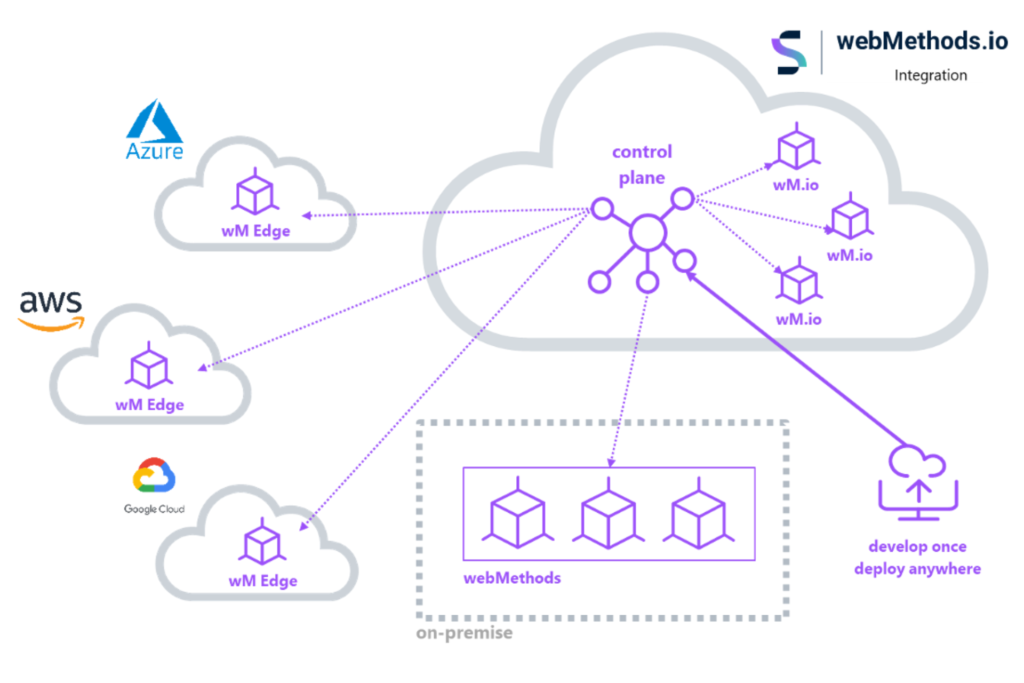
The platform brings application integration, APIs, events, messaging, B2B transactions and file transfers into a unified experience across on-premises and multicloud environments. Its hybrid control plane provides a centralized place to discover, manage and monitor integration assets, while integrations can continue to run in the environments where they are needed.
That distinction matters.
Enterprises don’t necessarily need every integration to run in one location. They need visibility and control across the locations where those integrations actually run.
The result is closer to a central command layer for a distributed integration estate. Teams can trace transactions, monitor runtimes, discover reusable assets and manage APIs. They can also manage these integrations without having to treat every environment as a separate island. IBM describes the hybrid control plane as a single place to govern and observe APIs, integrations, events and messaging across cloud, on-premises and hybrid deployments.
That can also change how organizations approach modernization.
Instead of replacing an entire technology landscape simply to make it easier to manage, companies can connect existing systems to newer applications and services and modernize in stages.
AI changes the integration equation
There is another reason this matters now.
AI introduces a new set of applications, APIs, agents and workflows that need access to enterprise information. An AI system can generate an impressive answer, but its usefulness inside a business depends on whether it can securely reach the right data and systems.
In effect, integration itself becomes part of the AI infrastructure.
IBM has added AI-powered capabilities to webMethods Hybrid Integration that can assist with building integration flows, mapping data, managing APIs and troubleshooting problems. Its Integration Agent, for example, can generate integrations across APIs, SDKs and events, while monitoring capabilities can help identify errors and suggest ways to resolve them.
There is also an AI Gateway designed to provide a centralized control point for interactions between enterprise applications and AI APIs, including usage monitoring, rate limiting and response caching.
The bigger idea is less about replacing developers with AI and more about removing some of the repetitive work that makes integration teams a bottleneck.
The value is ultimately measured outside IT
The strongest case for an integration platform is not the number of connectors it offers. It is what happens when those connections work reliably.
Faster integration development can mean a business gets a new service to market sooner. Better monitoring can mean problems are found before they become larger operational issues. Reusable APIs and integration assets can reduce duplicated work. Centralized governance can make it easier to maintain consistent policies across a sprawling environment.
“The Total Economic Impact™ Of IBM Integration,” a study commissioned by IBM, conducted by Forrester Consulting (November 2024) illustrates the potential financial impact. For its composite organization, the study calculated a 176% three-year ROI, 33% to 66% time savings on integration projects, a 40% reduction in downtime and a payback period of less than six months. These are modeled, risk-adjusted results rather than a guarantee for every organization, but they illustrate why integration is increasingly being evaluated as a business investment rather than simply an IT expense.
The impact becomes clearer when viewed through industries where systems, data and partners need to work together continuously. In logistics, for instance, integration is critical to keeping information moving across a complex supply chain. Hellmann Worldwide logistics was facing rising operating, maintenance and development costs with an existing technology platform, making growth and acquisitions more difficult. By implementing IBM webMethods, the company integrated interfaces across its logistics value chain, supporting data transfer, validation and custom business logic. The transformation ultimately migrated and integrated more than 750 application interfaces and supported over 500 customers, helping Hellmann standardize its integration environment while improving operational efficiency and business resilience.
Integration is becoming infrastructure for the enterprise
The irony of modern enterprise technology is that every new system is supposed to make business more capable, but without a way to connect those ecosystems, each addition can make the overall environment harder to manage.
Which is why the conversation about integration itself is shifting.
It is no longer simply about moving data from point A to point B. It is about giving an enterprise a way to connect its existing technology, modernize without unnecessary disruption, govern an increasingly distributed environment and create a foundation for new applications and AI-driven workflows.
IBM webMethods Hybrid Integration is built around that broader idea: connect the enterprise without forcing the enterprise into a single environment.
For organizations dealing with years of accumulated technology decisions, that may ultimately be a more practical path forward — not starting over but finally getting control of everything that has been built.