

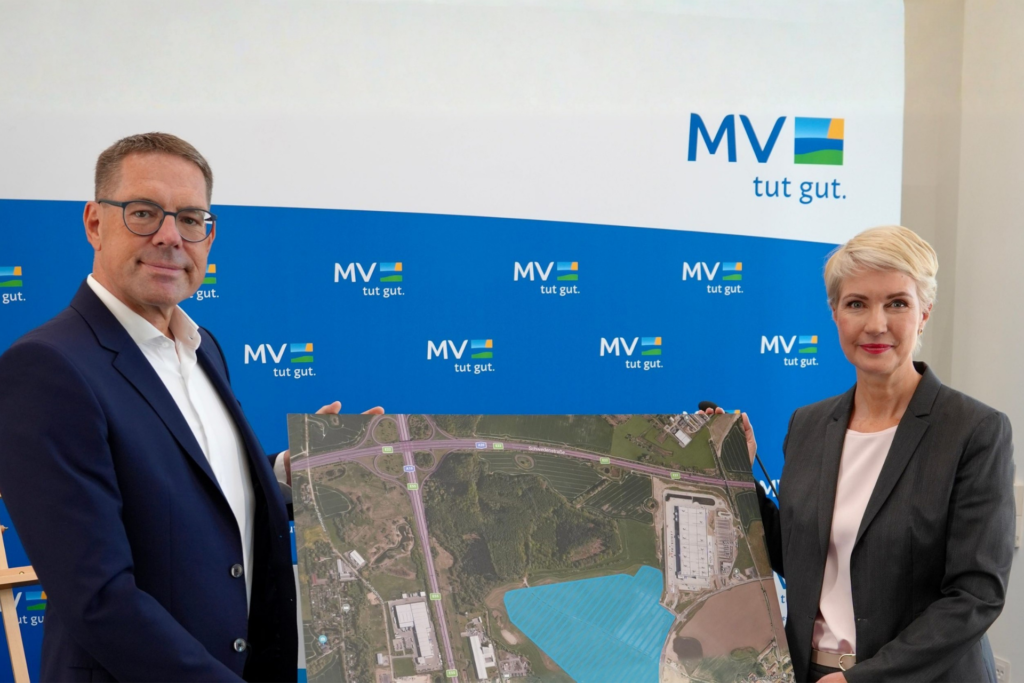
Gerd Chrzanowski, general partner Schwarz Group: “Digital sovereignty is not created by appeals or speeches. It is created by action, by reliable infrastructure, and by practical applications. We are not waiting for others to lead. We are assuming entrepreneurial responsibility and investing sustainably in the future of Germany as an economic location.”
Manuela Schwesig, minister-president of Mecklenburg-Vorpommern: “The goal of the state government is to become more independent from foreign providers of data centers and cloud and AI applications. We therefore view the Schwarz Group’s investment decision as an opportunity for greater independence and increased data security. Our state will benefit from this investment in many ways.”
Potential for 1-Gigawatt Grid Connection
Subject to standard approvals, the data center is expected to reach a capacity of 240 megawatts by 2033. The companies of Schwarz Group plan to utilize this capacity for their own ecosystem while also strengthening the further development and scaling of sovereign IT solutions, consolidated under the IT and digital division, Schwarz Digits. This offers very concrete prospects for expanding capacity to a grid connection of 1 gigawatt by 2045.
5.6 Billion Euros for Infrastructure in Mecklenburg-Vorpommern
The site currently under consideration for the data center is located in the industrial park in the municipality of Dummerstorf. An advantage of Northern Germany is the high availability of sustainably produced electricity, including wind power from both onshore and offshore sources. The proposed site also allows for connection to the 380-kilovolt extra-high-voltage grid. Extra-high-voltage lines make the transport of large volumes of electricity more efficient, and grid fees decrease as the voltage level increases.
Furthermore, the climate favors more efficient free cooling using ambient air. A letter of intent regarding the use of waste heat has been signed with the public utility of Rostock. The goal is to make the data center’s waste heat available sustainably to benefit municipal heating planning. For another data center project by the Schwarz Group in Lübbenau, Brandenburg, the parties involved recently signed contracts for a joint district heating concept.
The Dummerstorf project is in an early stage, and technical specifications – such as the exact requirements for the configuration of cloud and AI microchips – have not yet been finalized. The investment for the 240-megawatt capacity is priced at an estimated volume of approximately 5.6 billion euros.
Blueprint for All of Germany: Digital Administration and Citizen Services
The planned data center also underscores that the cooperation between the Mecklenburg-Vorpommern state government and Schwarz Digits in administrative digitalization is designed for the long term. Together, the partners are enabling a modern, efficient, and secure digital administration that brings tangible benefits to citizens and the economy.
Groundbreaking technical applications are slated for implementation in the state’s public administration by the end of 2026. These include digital building permits on the sovereign cloud platform STACKIT, as well as the introduction of OpenDesk, beginning with secure, fully managed teacher workstations in the education sector.
The cooperation is conceived as a scalable and transferable flagship project. The solutions developed are intended not only to modernize Mecklenburg-Vorpommern but to serve as a blueprint for the entire Federal Republic of Germany.