

A Region Awakening to Climate Opportunity
Between 2018 and 2022, climate tech startups in MENA and Turkey attracted approximately US$651 million in venture capital funding across nearly 148 startups. While modest compared to global giants, the trajectory signals a strong upward shift—especially considering the region’s historical reliance on hydrocarbons. (source – CARE by Trescon)
At the center of this transformation is the UAE, which alone accounts for about 62% (roughly US$401 million) of total funding during this period. The country has not only led in capital deployment but also in deal activity, nurturing a growing base of climate-focused startups.
Turkey follows closely in terms of startup volume, showcasing a vibrant entrepreneurial landscape, though with comparatively lower total investment value. Meanwhile, Saudi Arabia, Egypt, and Tunisia are steadily gaining traction, with investments of approximately US$68 million, US$42 million, and US$6 million respectively since 2018—highlighting a broader regional shift toward climate-conscious innovation. (source – CARE by Trescon)
Sectoral Focus: Where Innovation Meets Necessity
The Middle East’s climate tech growth is shaped by its unique environmental challenges such as water scarcity, extreme heat, and food security concerns, combined with its economic diversification ambitions. Climate innovation in the region is being driven across key sectors, including agri-tech, renewable energy, and water management. Startups are advancing solutions in precision agriculture, clean power, energy storage, and desalination to address food security, energy reliability, and water scarcity. At the same time, sustainable mobility is gaining traction with the rise of EVs and smart transport systems, supported by strong government policies and investment.
What’s Driving the Climate Tech Surge?
Several powerful forces are converging to accelerate climate tech adoption across the Middle East:
Climate tech growth in the region is being accelerated by strong policy support, global commitments, and increasing capital inflows. National net-zero strategies, post-COP28 momentum, and the rise of dedicated climate investment platforms are creating a robust ecosystem. Backed by sovereign funds and private investors, alongside improving technology affordability, startups are scaling rapidly while tapping into global collaborations and capital networks.
Sustainable Innovation
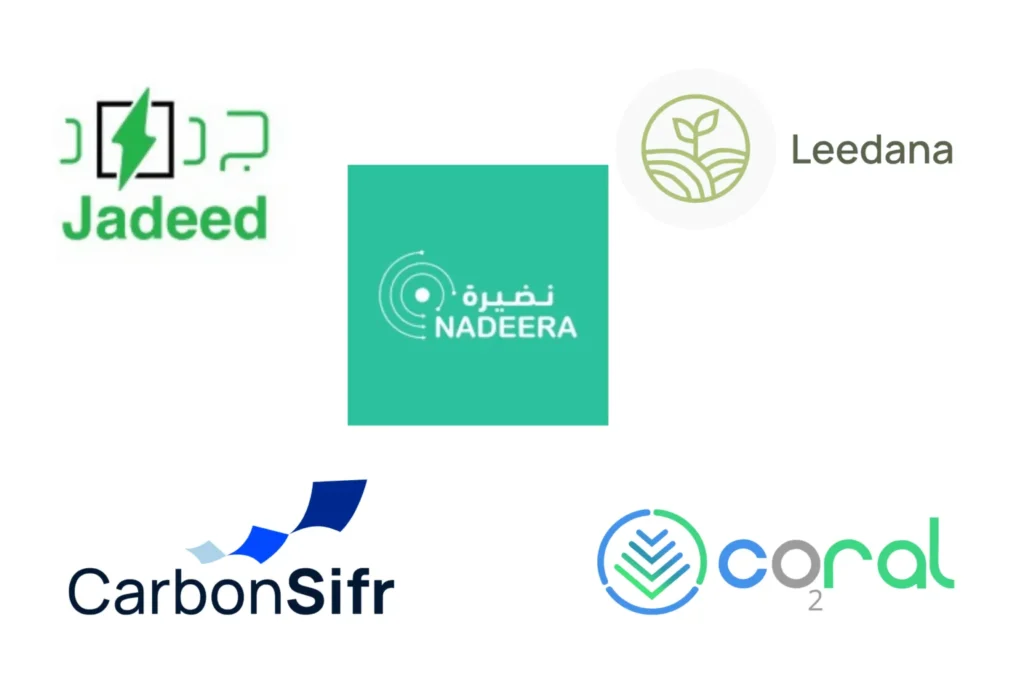
The region is emerging as a major hub for climate innovation, with strong focus areas including AI-driven carbon management, solar energy, and waste management. Notable players such as CarbonSifr (climate action), Nadeera (waste management), and Coral (carbon accounting) are driving this momentum.
In Saudi Arabia, climate tech is gaining significant traction under Vision 2030, with strategic emphasis on green hydrogen, renewable energy, and aquaculture initiatives like Mustadem.
Meanwhile, Egypt is witnessing high activity in agritech and food security, supported by innovative companies such as Jadeed (green energy) and Leedana (sandponics).
Strategic Investments
Climate tech investment in the Middle East is accelerating at an unprecedented pace, fueled by government-backed sovereign wealth funds (SWFs) driving economic diversification and long-term sustainability. Powerhouses such as the Saudi Public Investment Fund (PIF) with over $40 billion allocated, Abu Dhabi Investment Authority (ADIA) with more than $15 billion committed to renewables, along with CYVN Holdings and the Qatar Investment Authority, are leading this capital surge.
Complementing this momentum, a growing ecosystem of VCs and accelerators, including Hub71+ ClimateTech, Oryx, and Wamda Capital, is actively nurturing innovation and scaling next-generation climate solutions, positioning the region as a formidable force in the global climate tech landscape.
The Road Ahead
The Middle East’s climate tech journey is no longer just about adaptation—it’s about leadership. With strong government backing, increasing investor confidence, and a surge in entrepreneurial activity, the region is building a robust foundation for sustainable innovation.
However, challenges remain. Scaling startups, deepening R&D capabilities, and ensuring cross-border collaboration will be critical to maintaining momentum. Bridging the gap between early-stage innovation and large-scale deployment will define the next phase of growth.
As climate urgency intensifies globally, the Middle East is stepping into a new role—not just as a participant, but as a catalyst in shaping the future of climate technology.